

December 26, 2025
By Manjeet Singh Sandhu
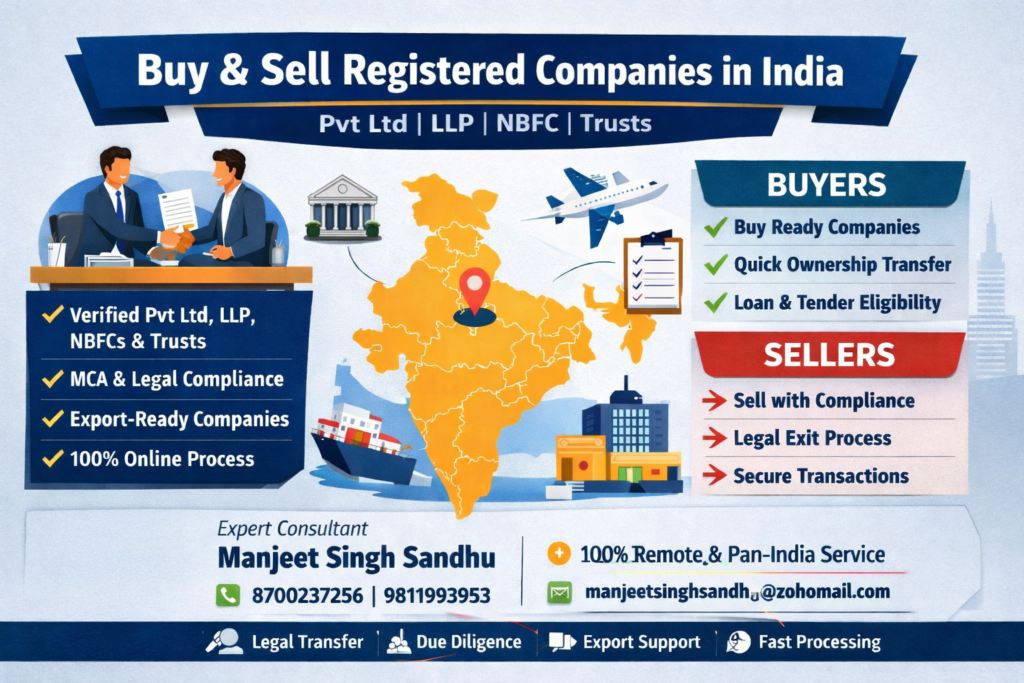
Buy and sell registered companies in India has become one of the fastest and most reliable business strategies in 2025. Instead of waiting weeks or months for new incorporation, entrepreneurs, investors, exporters, and corporate groups now prefer acquiring MCA-compliant Pvt Ltd companies, LLPs, running companies, and NBFCs with existing registrations. Buying an existing company offers instant credibility, faster access to business loans, project finance, and bank approvals, while selling a dormant or running company provides a clean, legally compliant exit. This guide explains the complete legal process, benefits, and risks involved in company buying and selling in India.
Why Buy and Sell Registered Companies in India Instead of New Registration?
In today’s competitive environment, time and compliance history matter more than ideas alone. New company registration often involves delays, documentation hurdles, and limited trust with banks and vendors.
Buying an existing registered company provides immediate advantages:
✔ No incorporation delay
✔ Existing PAN, TAN, GST & bank account
✔ Higher credibility with banks and investors
✔ Faster eligibility for business loans and project finance
✔ Compliance history already available
✔ Easier approvals for tenders, licenses, and contracts
That’s why company buying and selling in India is rapidly replacing fresh incorporation for serious businesses.
Types of Registered Companies Available for Sale in India
Depending on business goals, buyers and sellers usually deal in:
- Private Limited Companies
- Limited Companies
- LLP (Limited Liability Partnership)
- Running Companies with Turnover
- Dormant & Shelf Companies
- NBFCs (subject to RBI approval)
- Trusts & Section 8 Companies (eligibility-based)
Each structure serves a specific purpose—whether it’s funding, exports, compliance, or expansion.
Company Buying and Selling Process in India (Step-by-Step)
1. Explore Verified Company Listings
Buyers review verified companies based on:
- Year of incorporation
- Compliance and filing status
- Business activity
- Regulatory registrations (GST, IEC, etc.)
2. Buyer Interest & Confidential Screening
Only serious buyers proceed through a controlled and confidential process.
3. Buyer & Seller Verification
Identity and intent verification prevents fraud and fake inquiries.
4. Legal Company Acquisition and Due Diligence
This is the most critical stage and includes:
- MCA & ROC compliance verification
- Income tax and GST filings
- Shareholding structure review
- Pending liabilities, notices, or disputes
5. Documentation and MCA Filings
- Share transfer deeds
- Board resolutions
- Director changes
- Statutory MCA forms
6. Ownership Transfer and Control
Legal control of the company is transferred to the buyer.
How Selling a Registered Company Works
For company owners, professional assistance ensures a safe and dispute-free exit:
- CIN-based company verification
- Confidential approved listing
- Only genuine buyer leads
- Negotiation and legal support
- Proper documentation to avoid future liability
This is the safest way to sell a private limited company in India or exit a dormant entity.
Why Legal & Compliance Due Diligence Is Non-Negotiable
Buying a company without proper checks can expose buyers to:
- Hidden tax liabilities
- Legal disputes
- MCA penalties
- Banking and loan rejections
That’s why MCA-compliant company transfer with expert due diligence is essential—not optional.
Authority Behind the Process – Manjeet Singh Sandhu
This guide is authored by Manjeet Singh Sandhu, a senior business consultant with 15+ years of hands-on experience in:
- Company buying and selling in India
- Corporate law & MCA compliance
- Business loans & project finance
- Export–import documentation (IEC)
- Customs clearance & logistics
- Legal drafting and advisory
He follows a single-window consulting model, offering end-to-end solutions through one expert team.
✔ 100% online & paperless
✔ Pan-India service coverage
Why Businesses Trust Manjeet Singh Sandhu
✔ 15+ years of real industry experience
✔ Strong CA, CS & Advocate network
✔ One-stop solution for business, legal & finance
✔ Transparent pricing & fast turnaround
✔ Trusted by startups, SMEs, exporters & corporates
Trust is built on results—not promises.
How Buying a Company Helps with Loans & Finance
For readers of LoansAndFinance.in, company acquisition directly improves:
- Business loan eligibility
- Project finance approvals
- Working capital access
- Export finance readiness
- Investor and lender confidence
Banks and financial institutions prefer existing, compliant companies over newly incorporated entities.
Buy & Sell Companies Safely in 2025 and Beyond
With tighter regulations and increased scrutiny, professional guidance is more important than ever. Verified platforms combined with expert consultants ensure:
- Legal safety
- Complete transparency
- Faster execution
- Long-term business stability
📞 Contact for Consultation
🌐 100% Remote & Pan-India Service
📱 8700237256 | 9811993953
📧 manjeetsinghsandhu@zohomail.com
❓ Frequently Asked Questions (FAQs)
1. What does buying a registered company in India mean?
It means acquiring legal ownership of an existing MCA-compliant company through proper share transfer.
2. Is company buying and selling legal in India?
Yes, company buying and selling in India is legal when done through MCA filings and compliance.
3. Which types of companies can be purchased?
Pvt Ltd, LLP, Limited companies, NBFCs (RBI approval required), and Trusts.
4. Why do businesses buy ready-made companies?
To save time, gain credibility, and access loans and tenders faster.
5. How long does ownership transfer take?
Usually 15–30 working days.
6. Can dormant companies be sold?
Yes, dormant companies can be legally sold after compliance verification.
7. Does buying a company include bank accounts?
Yes, subject to bank KYC updates and approval.
8. Can buying a company help with business loans?
Yes, banks prefer existing compliant companies.
9. What checks should buyers perform?
MCA filings, tax returns, GST status, liabilities, and legal records.
10. Can exporters buy companies for immediate exports?
Yes, exporters buy companies with IEC, GST, and bank accounts.
11. Can I buy a running company with turnover?
Yes, subject to financial and legal due diligence.
12. Can foreign investors buy Indian companies?
Yes, under FDI and FEMA guidelines.
13. What role does MCA play?
MCA records share transfer and director changes.
14. Can NBFCs be bought in India?
Yes, only with RBI approval.
15. Does selling a company remove future liability?
Yes, if documentation is correctly executed.
16. What documents are required for transfer?
Share transfer deeds, board resolutions, KYC, and MCA forms.
17. Do startups benefit from buying companies?
Yes, for faster entry and funding access.
18. Does company acquisition help in tenders?
Yes, existing companies qualify faster.
19. Are services available Pan-India?
Yes, 100% remote services across India.
20. Who should consult before buying or selling?
An experienced business acquisition consultant in India.
Conclusion
In a compliance-driven economy, buy and sell registered companies in India has become a powerful strategy for faster growth, easier financing, and risk-free exits. Whether you want to acquire a loan-ready company or sell an unused entity, expert guidance ensures legal safety, transparency, and long-term peace of mind.
company buying and selling in India, buy ready made company in India, sell private limited company India, company takeover services India, business acquisition India
MCA compliant company transfer, legal company acquisition India, ROC and MCA filings, due diligence for company purchase
buy company for business loan, project finance ready company, running company with bank account, company acquisition for funding
ready company vs new registration, benefits of buying existing company, risks of buying company without due diligence, how to legally sell a company in India